
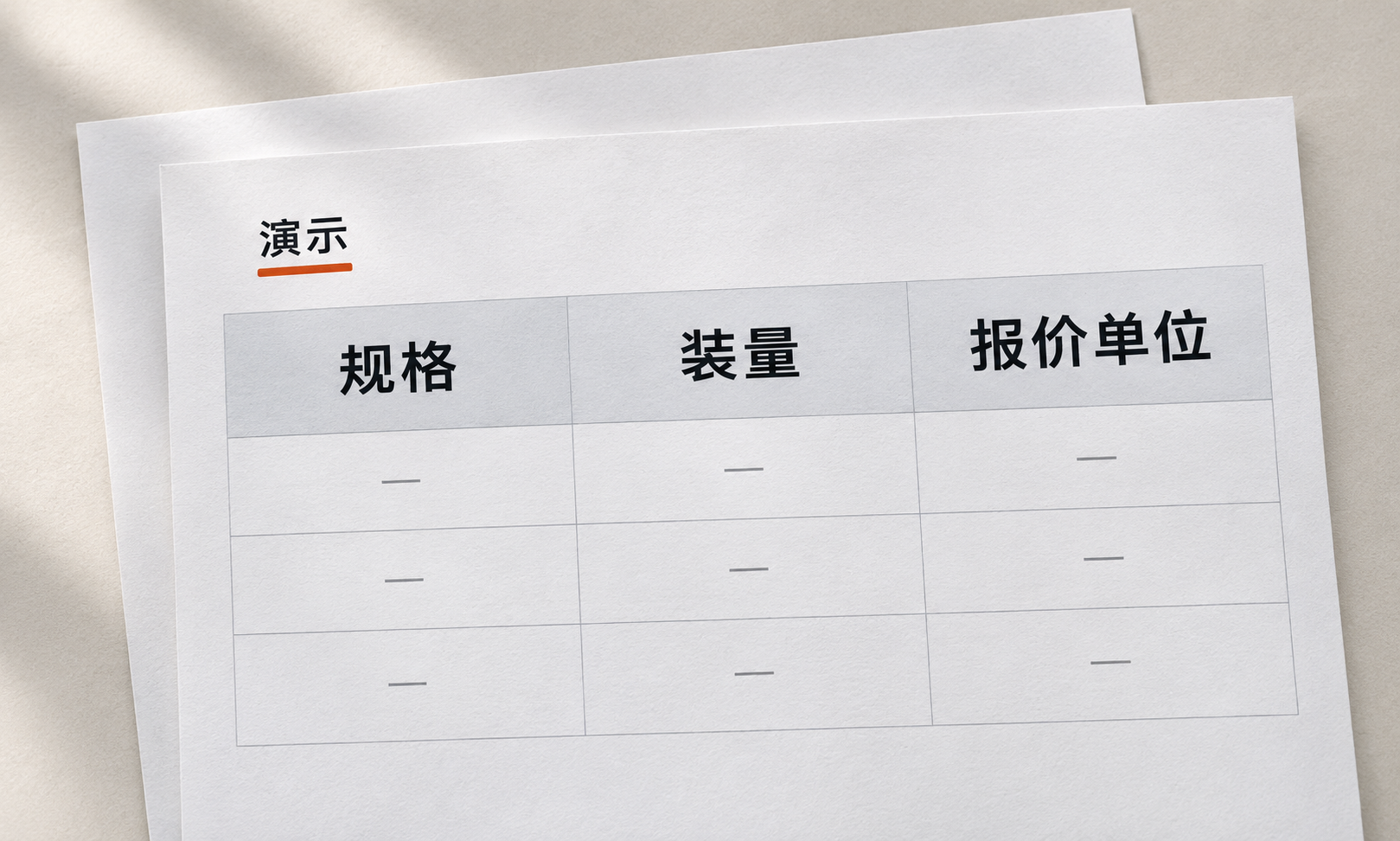
When you give AI two quotes, start by identifying the products: are they the same model, grade, and product condition? Once that is clear, align quantities and quote units. The resulting table can then support a purchasing decision.
Separate the product from the quote
At a minimum, keep separate fields for the product name, model or specification, capacity per item, items per case, quoted amount, currency, quote unit, and original source. Record shipping, taxes, minimum order quantities, validity periods, and other conditions separately.
Do not leave “500 mL × 6” as a specification string that is hard to work with: 500 mL is the capacity per bottle, 6 is the number of bottles per case, and the quote may be per bottle or per case.
Compare prices using the same denominator
The following example demonstrates unit conversion. These are not real supplier quotes. Assume the other product conditions are the same:
Scroll horizontally to see the full table.
| Sample record | Capacity per bottle | Pack size | Quote | Total capacity per case | Price per liter |
|---|---|---|---|---|---|
| Source A | 500 mL | 6 bottles/case | CNY 60/case | 3 L | CNY 20/L |
| Source B | 1 L | 3 bottles/case | CNY 72/case | 3 L | CNY 24/L |
The calculation is short: Source A gives 0.5 × 6 = 3 L and 60 ÷ 3 = CNY 20/L; Source B gives 1 × 3 = 3 L and 72 ÷ 3 = CNY 24/L. Converting both quotes to a price per liter makes the difference clear.
This is still not a final purchasing decision. If the formulation, grade, packaging, shipping, or taxes differ, keep those differences visible.
Give AI a more specific task
Organize the product information into a comparison table. Keep separate fields for specifications, capacity per item, items per case, currency, quote unit, and source. Align units only where conversion is clearly possible. Mark missing information as “To confirm” and list the questions that need follow-up.
To check the result, pick one row at random and return to its source, then verify one unit conversion. If a pack size is missing, do not assume it means one bottle. Keep different currencies as quoted; confirm the exchange rate and conversion date separately.
Decide where a tool fits
Web collection tools can help obtain source material, while a model helps organize and analyze it. Domain fields and checking methods connect both parts within the same task. Start with the roles of Firecrawl and Apify, then look at the task examples in SilexHub E-commerce.
Keep the original records and sources. When a quote changes, you can then tell whether the price, pack size, or product itself has changed.
Tools in this article
Find the right tools for the job
Review inputs, outputs and task samples to decide whether a tool fits your work.
Explore task samples